Hidden History · Queer Life · Literature
Thelma Wood, Djuna Barnes,
and Nightwood
Henrietta McCrea Metcalf lived a life that extended far beyond her marriages and her translations. From 1928 to 1943, she was the partner of sculptor Thelma Wood — and in doing so, became a character in one of the most celebrated modernist novels of the twentieth century.
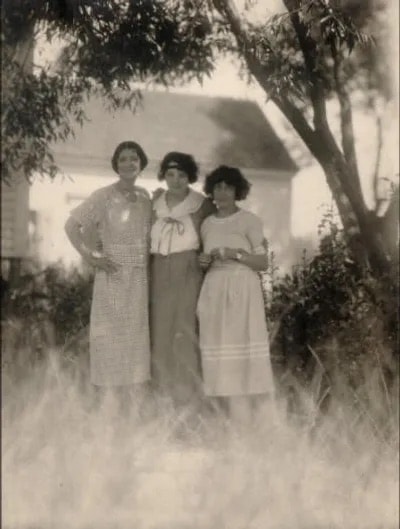
Helen Ware, Josephine Victor, and Henrietta Metcalf — 1923.
Part of the Henrietta Alice Metcalf Performing Arts Photographic Collection, University of Kentucky Libraries Special Collections Research Center.
Meeting Thelma Wood
In 1928, Henrietta McCrea Metcalf met Thelma Wood — an American sculptor and silverpoint artist living in Paris. Wood was, at the time, still in a relationship with the writer Djuna Barnes, one of the central figures of the expatriate modernist circle. Wood left Barnes to be with Henrietta.
The relationship was acknowledged openly within Henrietta’s family. Her son Addison Metcalf referenced Wood in letters to his mother. The two women moved first to Greenwich Village in New York, then in 1932 to Florence, where Wood studied art — supported financially by Henrietta. In 1934 they relocated to Sandy Hook, Connecticut, where Wood launched a gourmet catering service, again with Henrietta’s backing.
The relationship lasted until 1943 and ended badly. When Wood was on her deathbed, she asked to see Henrietta. Henrietta refused.
“Wood left Barnes to live with McCrea. In Nightwood by Barnes, some said McCrea is ‘Nora Flood’, more others said she is ‘Jenny Petherbridge’.”
— Wikipedia, Henriette Alice McCrea-Metcalf
Immortalized in Nightwood
Djuna Barnes published Nightwood in 1936, with a preface by T.S. Eliot. The novel — set in the queer expatriate world of 1920s Paris — drew directly from Barnes’ own life and relationships. Thelma Wood, who had left Barnes for Henrietta, became the model for the character Robin Vote, the elusive, destructive center of the novel’s emotional world.
Scholars have long debated which character represents Henrietta. Some argue she is Nora Flood — the devoted, heartbroken woman who loses Robin. Others argue she is Jenny Petherbridge — the woman who takes Robin away. The ambiguity is fitting. Henrietta was both: the one who took Thelma from Barnes, and the one who was ultimately abandoned by her.
Nightwood is considered one of the greatest modernist novels in the English language. Henrietta McCrea Metcalf — granddaughter of a murdered Chicago toll road baron — is woven into its pages.
Her Queer Places
The addresses associated with Henrietta’s queer life form a geography of her hidden history:
764 West Adams Street, Chicago
Her childhood home — where she was born into the Snell family fortune
720 Lincoln Park Boulevard, Chicago
Where she lived on returning from Europe in 1910, before her marriage to Willard
Greenwich Village, New York
First home with Thelma Wood after 1928
Florence, Italy
Where she and Wood lived 1932–1934; Wood studied art on Henrietta’s support
Sandy Hook, Connecticut
Where Wood launched her catering service, 1934; the relationship ended here in 1943
86½ Main Street, Newtown, Connecticut
Where Henrietta lived in the 1950s
Ye Kit and Kaboodle, 7 Liberty Street, Bridgeport, CT
The animal welfare antique shop she co-founded; proceeds went to care for stray animals
A Life Beyond the Margins
Henrietta’s queer life was only one dimension of a remarkably full existence. In 1915 she directed the Employment Bureau of the Central YWCA in New York and opened a catering service training women as waitresses for wealthy clients. In 1926 she served as executive secretary of the Education Committee of the Roosevelt Memorial Association for Women.
In 1952 she adopted Jacobus Arnoldus Metcalf. In the 1970s she let people farm four acres of her land in a project to have young people work alongside their fathers. She was a member of the Board of Directors for the Planned Parenthood League of Connecticut. She was an animal welfare activist, involved with PAWS, Friends of Animals, and the Humane Society.
She died on May 27, 1981, at the age of 92. Her son Addison founded a scholarship in her name at the American Academy of Dramatic Arts. Her performing arts photograph collection — spanning 1880 to 1955 — is housed at the University of Kentucky Libraries Special Collections Research Center.