400+
Properties owned at death
Real estate across Chicago and Cook County
$2M+
Estate value, 1888
Equivalent to tens of millions today
55 yrs
Estate battles lasted
Legal wrangling continued until 1943
136 yrs
Murder unsolved
No conviction ever secured

Personal Essay
Understanding the Legacy
What does it mean to be descended from a man like Amos Jerome Snell — brilliant, controversial, powerful, and murdered? A Black woman's reckoning with a complicated inheritance, 136 years later.
Read Robin's Essay →
Historical Discoveries
What the Research Has Confirmed
Every entry below is drawn from primary sources — court records, newspaper archives, university documents, and DNA research. Ongoing items are clearly marked.
Born in Chautauqua County, New York. Arrived in Chicago as a young man with little more than ambition.
Snell purchases the Northwestern Plank-Road for $20,000 and builds a toll monopoly stretching from Chicago to the Lake–Cook county line.
Shot dead in his own mansion on February 9, 1888. No will was found. The suspected killer, Tascott, was never convicted. The case remains officially unsolved.
Heirs fight to keep the toll road. Both the Illinois Supreme Court (133 Ill. 413) and the U.S. Supreme Court (152 U.S. 191) rule the toll right died with Snell.
Henrietta Snell donates $60,000 to the University of Chicago for a men's residence hall. The Snell name is permanently inscribed on the campus.
Alice — voted one of Chicago's most beautiful women, painted by Julian Russell Story — dies in New York Hospital. Her oil portrait is later discovered at the Florence Griswold Museum.
The only son of one of Chicago's wealthiest men dies in a lodging house at age 52 with nothing to his name.
Legal wrangling over Snell properties stretches across five decades. Shares are still being argued over in 1943 — 55 years after his murder.
Robin Beckham discovers her connection to the Snell line through DNA results and genealogical research — tracing the line through Alice Snell McCrea.
The Snell Name Lives On
Snell Hall — Henrietta Snell's Gift to the University of Chicago

Widow of Amos J. Snell · Donor of Snell Hall
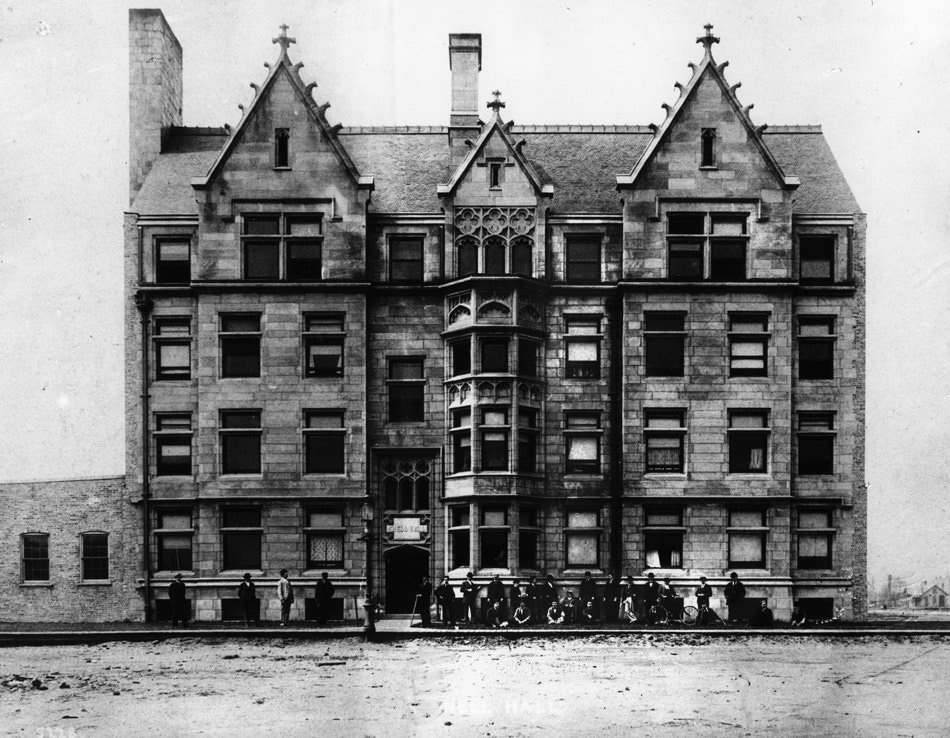
University of Chicago Photographic Archive [apf2-07438]
One of the University of Chicago's most pressing obligations in its first years was to provide adequate housing for its students. President Harper believed a successful college experience required adequate on-campus living quarters — yet plans for women's residence halls were still incomplete even after the University opened its doors in 1892.
In 1893, administrators temporarily reassigned female students to Snell Hall — a men's residence hall funded by a $60,000 gift from Henrietta Snell, widow of Amos J. Snell. The building stood as one of the University's earliest residential facilities, a lasting physical monument to the Snell family's place in Chicago history.
Henrietta's donation came just a few years after her husband's murder in 1888 — a time when she was simultaneously managing a fractured estate, fighting legal battles over the toll roads, and offering a $50,000 reward for the capture of his suspected killer. That she also found the means and the will to endow a university residence hall speaks to the kind of woman she was.
$60,000
Henrietta's gift
1892
University opens
1893
Snell Hall opens
"A legacy is not only what we inherit — it is what we preserve and pass on."
— Robin Beckham, Descendant & Researcher
Amos Snell was murdered in 1888. His estate — some 400 properties, toll road rights, and millions in real estate — became the subject of lawsuits, court battles, and family feuds that stretched across five decades. His story is still being written.
Get in Touch
Contact Robin Beckham
Have information about the Snell family, the 1888 murder, or a connection to this history? Robin welcomes correspondence from researchers, journalists, and descendants.